
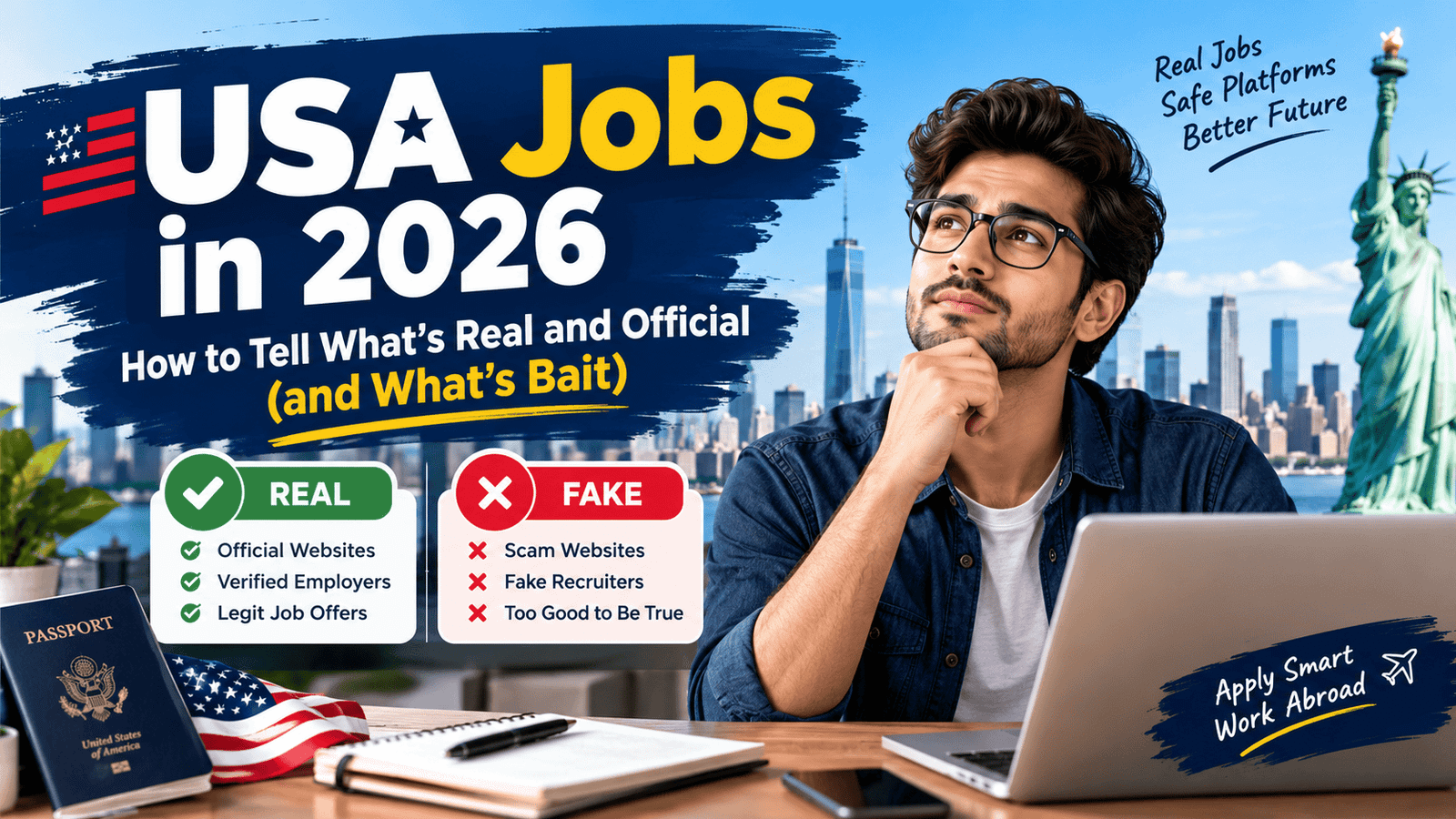
A message lands in your inbox: “Congratulations! You’ve been selected for a job in the USA. Visa sponsorship included. Pay the processing fee to continue.”
If you’ve ever searched for work in America from outside the country, you’ve probably seen some version of that. It feels exciting for about ten seconds. Then you realize you never applied anywhere.
I’ve watched people lose real money to messages like this, often not careless people, just hopeful ones. [ADD YOUR OWN: a time you or someone you know got a suspicious offer, and what gave it away]
This guide covers where real US jobs are actually posted, how to check that an employer exists, how the visa side works in 2026, and the red flags that should make you close the tab.
Start with the places that are actually official
Most scams work because people don’t know where real listings live. These are the sources I’d trust first.
USAJOBS.gov is the US federal government’s official job site. Every federal agency posts here. One thing people miss: most federal jobs are limited to US citizens. Use the filter for “Open to the public” and read the “Who may apply” section before spending an hour on an application.
CareerOneStop and your state’s job bank. CareerOneStop is sponsored by the US Department of Labor, and each state runs its own workforce agency site with local listings. These are plain and not very pretty, but they’re real.
The Department of Labor’s seasonal jobs listings. Seasonal farm and non-farm employers who sponsor foreign workers (the H-2A and H-2B programs) have to file job orders with the government. If an offer claims to be one of these jobs, you can look for the order instead of trusting a stranger’s word.
Company career pages and LinkedIn. Go to the employer’s own website, find the careers page, and apply there. If a recruiter sends you a link, don’t click it. Search for the company yourself and see whether the same job is listed.
How the visa side works in 2026
Most people who want to work in the US need an employer to sponsor them. Three things are worth knowing.
The employer does the paperwork and pays the government fees. For H-1B work visas, the company files the petition. A legitimate employer doesn’t ask you to buy the visa from them. The same goes for H-2A and H-2B seasonal visas, where recruitment fees charged to workers are not how the programs are supposed to work.
Nobody can sell you a guaranteed visa. The H-1B starts with an employer registration, and selection is by lottery, so no recruiter can promise an outcome. Anyone who says “100% visa guaranteed” is lying.
The H-1B cost picture has been messy. A presidential proclamation in September 2025 set up a $100,000 payment for certain new H-1B petitions, mainly for workers outside the US. A federal court ruled the fee unlawful on June 8, 2026, and after it was briefly restored on appeal, the First Circuit reinstated that ruling on July 24, 2026. As of late September, neither USCIS nor the State Department could collect it. The government’s appeal is still pending, so the situation could change again. There is also a separate proposed DHS fee of $103,265 that, as of early October, was only a proposal and not a mandatory charge. $100,000 H-1B fee – Current status +3
The practical lesson is that the rules around this are shifting. Check USCIS.gov directly, and if your situation is complicated, talk to an immigration attorney before you spend money or quit anything.
Step by step: how to check whether a job offer is real
This is the routine I’d follow for any offer that comes to you.
Step 1: Look at the sender’s email address. A real recruiter at a real company writes from the company’s domain. A Gmail, Yahoo or Outlook address claiming to be “HR at [big company]” is a warning sign.
Step 2: Find the job on the company’s own site. If it isn’t listed there, ask yourself why.
Step 3: Search the company name plus the word “scam.” It takes thirty seconds, and you’d be surprised how often it ends the whole thing.
Step 4: Check the sponsorship record. If the job claims H-1B sponsorship, USCIS has an H-1B Employer Data Hub where you can look up whether that company has filed petitions. The Department of Labor also publishes public data on labor condition applications. A company that sponsors in real life usually has a paper trail. A company with no record isn’t automatically fake, but you should ask harder questions.
Step 5: Insist on a real interview. Real employers talk to you by video or phone, ask about your actual skills, and let you ask questions back. If the whole process is a chat app and a typed questionnaire, be suspicious.
Step 6: Never pay to get the job. Not for training, not for a “security deposit,” not for a medical test, not for a visa slot. Legitimate employers pay you.
Red flags I’d walk away from immediately
- You’re asked for money before you start, in any form.
- The offer comes within hours of a “chat” interview on WhatsApp or Telegram.
- They want a copy of your passport, bank details or Social Security number before there’s a signed offer.
- They send you a check and ask you to wire back “extra” money. The check will bounce and you’ll owe the bank.
- The salary is far above the market for a role with no experience required.
- The messages are full of urgency: “respond in 24 hours or lose your slot.”
- They guarantee a visa or green card.
[ADD YOUR OWN: one red flag you personally ran into that isn’t on this list]
Mistakes I see people make
Applying everywhere and tracking nothing. If you send fifty applications and keep no record, you can’t tell a real follow-up from a scam that happens to mention a job you once looked at. Keep a simple spreadsheet with company, link, date and contact.
Trusting a logo. Scammers copy logos, signatures and even real recruiters’ names. A familiar brand on an email proves nothing.
Paying a “consultant” for access to jobs. Some consultants are legitimate, but many sell things that are free, like a list of USAJOBS listings. If someone offers “exclusive” access to jobs that are posted publicly, you’re paying for nothing.
Assuming a visa can be fixed later. Taking a job abroad without understanding your work authorization is how people end up in serious trouble. Settle it first.
Ignoring your own gut. If an offer feels too easy, it usually is.
What to do if you think you’ve been scammed
Stop all contact, and don’t send more money to “fix” the problem. Save every message, receipt and email. Then report it. In the US, the FTC takes reports at ReportFraud.ftc.gov, and the FBI’s Internet Crime Complaint Center handles online fraud at ic3.gov. If money went through a bank or payment app, call them right away, since speed matters.
A realistic way to approach this
A real US job search from abroad is slow. It usually involves a strong resume, employers in fields that regularly sponsor, such as healthcare, engineering and software, and a lot of patience. Real offers come out of real conversations, not unsolicited messages.
If you take one habit from this, make it this one: never go to the offer, make the offer come to the source. Find the job on the official site or the company’s own page, verify the employer, and keep your money in your pocket until you’re the one getting paid.
If you’ve got a question about a specific offer you’ve received, drop it in the comments and I’ll tell you what I’d check first. And please, don’t send anyone your passport scan to “reserve your visa.”
Before you publish:
- Fill in the three [ADD YOUR OWN] spots with real experiences. Google and readers both reward that, and it keeps the post honest.
- Re-check the H-1B fee section the day you publish, since it’s the most likely part to change.
- Add a short line like “This is general information, not legal advice” near the visa section.
- Link out to USAJOBS.gov, USCIS.gov and ReportFraud.ftc.gov so readers can verify everything themselves.