Imagine your car suddenly breaks down on the way to work. At the same time, rent is due, and your savings are not enough to cover both expenses. You start searching online for a loan in the USA, and within minutes, you find dozens of lenders promising quick approvals, low interest rates, and money deposited directly into your bank account.
It sounds simple until you look closer. One lender advertises a low interest rate but charges additional fees. Another offers a longer repayment period but costs more over time. A third promises approval even if your credit history is not perfect.
This is where understanding how loans work becomes important.
Whether you need money for an emergency, a car, a home, education, or a small business, the U.S. lending market offers several options. However, the right choice depends on your financial situation, credit history, income, and ability to repay the money.
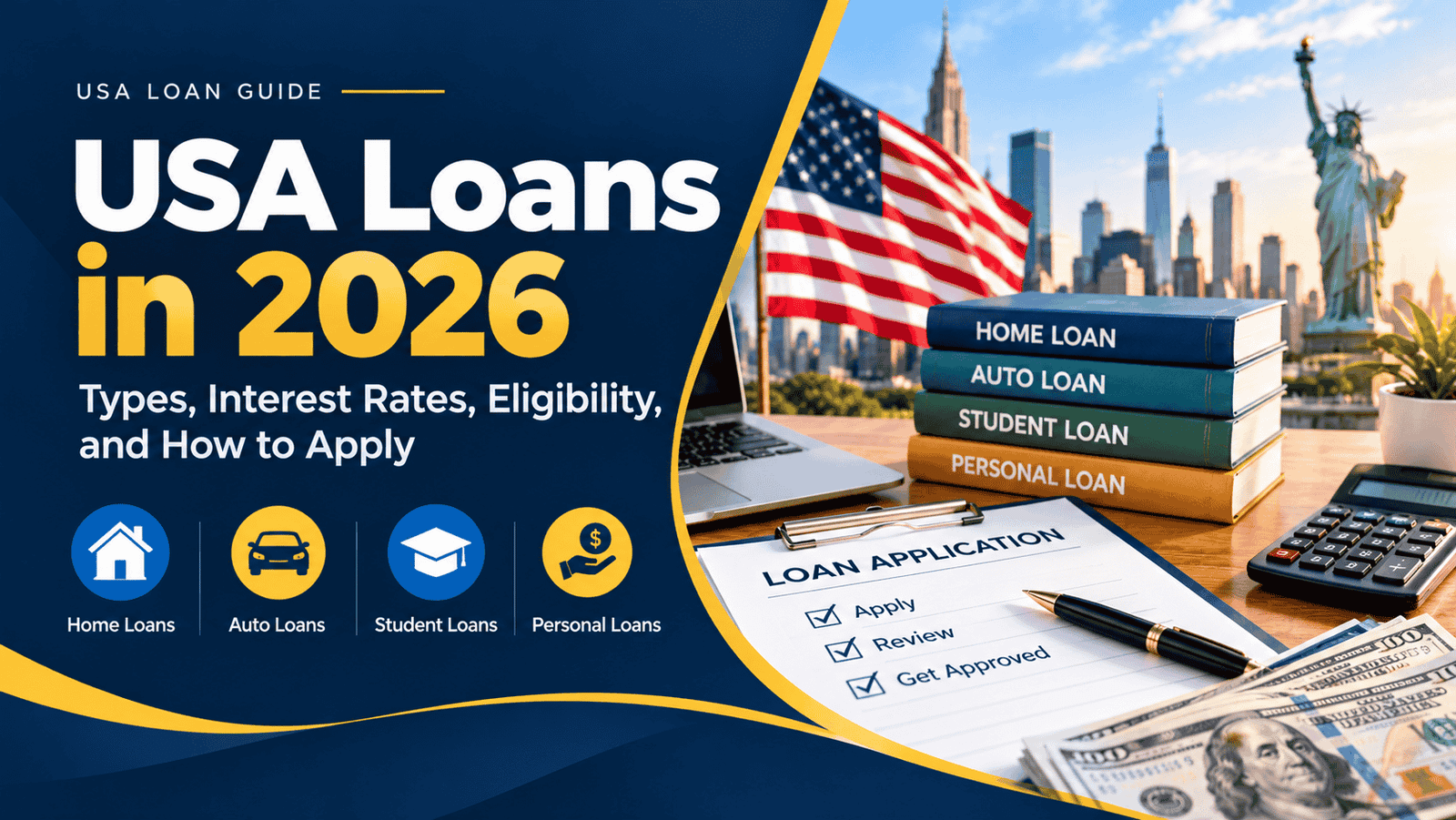
This guide explains the main types of loans in the USA in 2026, how applications work, what lenders consider, and how to compare offers without falling into expensive debt.
What Is a Loan in the USA?
A loan is money borrowed from a bank, credit union, online lender, government-backed program, or another financial institution. You agree to repay the borrowed amount, usually with interest and possibly additional fees.
The original amount you borrow is called the principal. The interest is the cost of borrowing that money.
Most loans have a repayment schedule. Depending on the agreement, you may make payments weekly, monthly, or according to another schedule. Some loans have fixed payments, while others have rates or payment structures that can change.
For example, if you borrow $10,000 for a personal expense, you will generally repay more than $10,000 if interest and fees apply. The total depends on the interest rate, repayment term, fees, and payment schedule.
That is why comparing the amount you receive with the total amount you must repay is more useful than looking only at the advertised monthly payment.
Main Types of Loans Available in the USA
Different loans serve different purposes. Before applying, identify what you need the money for and whether the lender’s product matches that purpose.
1. Personal Loans
A personal loan can provide money for eligible expenses such as emergency repairs, medical bills, or debt consolidation. Many personal loans are unsecured, meaning you do not pledge a car or house as collateral.
Banks, credit unions, and online lenders offer personal loans. Approval requirements vary, and lenders may consider your credit history, income, existing debts, and other financial details.
Personal loans may have fixed monthly payments and a defined repayment period. Some lenders charge an origination fee, which can reduce the amount you receive or increase the overall cost.
Before accepting an offer, check:
- The annual percentage rate (APR).
- The total repayment amount.
- Whether an origination fee applies.
- The monthly payment and loan term.
- Whether early repayment carries a fee.
The Consumer Financial Protection Bureau explains that personal installment loans may include origination, documentation, and late fees. Read the lender’s disclosures before signing. Learn more from the CFPB.
2. Home Loans and Mortgages
Buying a house is one of the biggest financial commitments many people make. Most buyers cannot pay the full purchase price upfront, so they use a mortgage.
With a mortgage, a lender provides financing for the property, and the borrower repays the loan over an agreed period. The property typically serves as collateral. If the borrower fails to meet the mortgage obligations, the lender may have legal remedies that can ultimately include foreclosure.
Common mortgage options include:
- Conventional mortgages: Loans that are not directly insured or guaranteed by the federal government.
- FHA loans: Mortgages insured by the Federal Housing Administration, subject to eligibility requirements.
- VA loans: Home loans backed by the Department of Veterans Affairs for eligible borrowers.
- USDA loans: Certain rural housing loans backed by the U.S. Department of Agriculture, subject to program requirements.
Each option has different eligibility rules, down-payment requirements, mortgage insurance provisions, and fees.
A mortgage’s interest rate is important, but it is not the only cost to consider. Closing costs, property taxes, homeowners insurance, and maintenance can significantly affect the affordability of a home.
The CFPB recommends comparing multiple mortgage offers instead of accepting the first one. Its mortgage shopping guide explains how to compare lenders and loan terms.
3. Auto Loans
If you want to purchase a car, an auto loan can help you pay for it over time.
You may obtain financing through a bank, credit union, online lender, or dealership. Dealer-arranged financing can be convenient, but you should still compare the offer with other lenders.
Suppose a dealership advertises a vehicle with a manageable monthly payment. Before agreeing, check how much you will pay over the full term. A lower monthly payment might simply result from borrowing for longer.
Compare:
- The vehicle’s total price.
- Your down payment.
- The interest rate and APR.
- The loan term.
- Any additional products or fees.
- The total amount payable over the life of the loan.
Remember that a car can lose value while you are still paying for it. If the loan balance becomes greater than the vehicle’s market value, you may owe more than the car is worth.
The CFPB offers practical guidance on auto financing and comparing loan offers.
4. Student Loans
Education in the United States can be expensive, particularly when tuition, accommodation, books, and other living costs are included.
Student loans help eligible students pay education expenses, but federal and private student loans have different terms.
Federal student loans are offered under government programs and generally have standardized terms for eligible borrowers. Depending on the loan and circumstances, they may provide protections or repayment options that private loans do not.
Private student loans are provided by banks, credit unions, and other private lenders. Their interest rates, eligibility requirements, repayment terms, and cosigner rules vary.
Before borrowing, investigate scholarships, grants, work-study opportunities, and payment plans. Money that does not need to be repaid can reduce the amount of debt you take on.
Start with the official Federal Student Aid website. It explains federal student loan options, eligibility, and the application process.
5. Small Business Loans
Starting or expanding a business often requires money for equipment, inventory, staff, rent, or working capital.
Small business financing may come from banks, credit unions, online lenders, and specialized programs. Some loans are designed for established businesses, while others may require a detailed business plan and evidence of the ability to repay.
The U.S. Small Business Administration (SBA) supports certain loans through participating lenders. The SBA generally does not simply hand every business owner a grant or guaranteed cash payment; program eligibility and lender approval requirements still apply.
Before applying, prepare a realistic business budget, financial statements where available, information about your business, and a clear explanation of how the borrowed funds will be used.
Explore programs and eligibility requirements through the official SBA loan programs page.
6. Payday Loans and Short-Term Cash Advances
Payday loans are short-term loans that may be marketed to people who need cash before their next paycheck. They can be very expensive and may create a cycle of repeated borrowing.
The Federal Trade Commission explains that a payday loan charging $15 per $100 borrowed for two weeks translates to an APR of approximately 391%. State laws and loan terms vary, but the example shows why the fee and repayment schedule matter. <Cite refs={[“turn613904search1”]}/>
Before considering a short-term loan, check alternatives such as a credit union loan, a payment arrangement with a service provider, or a legitimate local assistance program.
If you cannot repay the loan on the due date without borrowing again, that is a warning sign that the loan may make your financial situation worse.
Understanding Loan Interest Rates and APR
One of the most common mistakes borrowers make is comparing loans by the interest rate alone.
The interest rate represents the cost of borrowing the principal. The annual percentage rate, or APR, generally includes the interest rate plus certain fees associated with the loan, providing a broader measure of borrowing costs.
For example, imagine two lenders offer similar loan amounts:
- Lender A: Advertises a lower interest rate but charges a substantial origination fee.
- Lender B: Offers a slightly higher interest rate with fewer fees.
Lender A might still be cheaper, or Lender B might be the better deal. You need to compare the actual APR, the repayment term, and the total amount payable to find out.
For mortgages, APR calculations have specific rules, and comparisons can be more complicated when loan structures differ. Review the official loan disclosures rather than relying on a headline advertisement.
The CFPB provides a useful explanation of interest rates versus APR.
What Credit Score Do You Need to Get a Loan?
There is no single credit score that guarantees approval for every loan in America.
Different lenders have different criteria, and the credit score required may depend on the type of loan, the amount requested, your income, your debt obligations, and the lender’s risk assessment.
In general, a stronger credit history may help a borrower qualify for more favorable terms. However, a good credit score does not guarantee approval, and a lower score does not automatically mean every option is unavailable.
Lenders may review factors such as:
- Payment history.
- Outstanding debt.
- Credit utilization.
- Length of credit history.
- Income and employment information.
- Existing monthly financial obligations.
Before applying, review your credit reports for errors and make sure the information is accurate. Avoid companies that promise to erase accurate negative information or guarantee that they can create a new credit identity.
You can find consumer credit guidance through the Consumer Financial Protection Bureau.
How to Apply for a Loan in the USA: Step by Step
A little preparation can make the application process easier and help you compare offers more confidently.
Step 1: Decide Exactly How Much You Need
Start with the expense you need to cover. Borrowing more than necessary can increase interest costs and make repayment harder.
For a car or home purchase, consider the total cost rather than only the down payment. For a personal loan, calculate the actual expense and avoid using the loan to cover unnecessary purchases.
Step 2: Review Your Budget
List your monthly income, rent or mortgage, utilities, food, existing debt payments, transportation costs, and savings needs.
Then estimate whether you can comfortably afford the proposed payment. Leave room for unexpected expenses instead of assuming every month will go perfectly.
Step 3: Compare Several Lenders
Check banks, credit unions, and reputable online lenders. For a mortgage, the CFPB recommends comparing multiple offers. The same general principle is useful for other loan types.
Compare APR, fees, loan term, monthly payments, and total repayment cost. Check whether the advertised rate is available to you or represents only the lowest rate offered to highly qualified applicants.
Step 4: Prepare Your Documents
Depending on the lender and loan type, you may be asked for:
- Government-issued identification.
- Proof of income.
- Employment information.
- Bank statements.
- Address and contact details.
- Information about existing debts.
- Collateral or property documents, where applicable.
Requirements vary, so follow the lender’s official checklist.
Step 5: Review the Offer Before Signing
Read the agreement carefully. Check the amount you will receive, APR, payment schedule, fees, late-payment rules, and any collateral requirements.
Do not sign simply because a representative says the offer expires soon. Ask questions until you understand the terms.
Step 6: Keep Your Records
Save the application confirmation, signed agreement, payment schedule, and lender contact information. After the loan is funded, check the account to confirm the balance and payment dates are correct.
A Practical Loan Example
Imagine you need to borrow $5,000 for an essential expense. One lender offers a 24-month repayment period, while another offers 36 months.
The second lender may advertise a lower monthly payment because you are repaying the money over a longer period. However, a longer term can mean paying more interest overall.
For illustration, assume a $5,000 loan has a fixed 12% annual interest rate and no fees:
| Repayment term | Approximate monthly payment | Approximate total interest |
|---|---|---|
| 24 months | $235.37 | $648.88 |
| 36 months | $166.07 | $978.52 |
These figures are estimates using monthly amortization and are not actual lender quotes. The example shows that a lower monthly payment does not necessarily mean a cheaper loan.
Choose a repayment term that fits your budget while considering the total amount you will pay.
Common Loan Mistakes to Avoid
Focusing Only on the Monthly Payment
A low monthly payment can hide a long repayment term or expensive fees. Always check the full cost.
Applying Without Checking Your Budget
Getting approved does not mean you can comfortably afford the payment. Your everyday expenses and existing debts still need to be covered.
Ignoring Additional Fees
Origination fees, late fees, documentation charges, and other costs can increase the amount you pay. Read the disclosures carefully.
Borrowing to Repay Other Borrowing Without a Plan
Debt consolidation may help in some situations, but it is not automatically a solution. If you consolidate debts and continue building new balances, your total debt can grow.
Trusting Guaranteed-Approval Advertisements
Be cautious when a company promises approval regardless of your financial situation, especially if it demands money before providing the loan.
The FTC warns about advance-fee loan scams in which fraudsters ask for supposed processing or insurance fees and then never provide the promised funds. <Cite refs={[“turn613904search0”]}/>
Ignoring State Laws
Rules governing lending, payday loans, fees, and consumer protections vary by state and loan type. Check the relevant state regulator when you are unsure about a lender or product.
How to Recognize a Loan Scam
Loan scams often target people who need money urgently or have difficulty qualifying for traditional financing.
Watch out for these warning signs:
- A lender guarantees approval before reviewing your application.
- Someone demands payment through gift cards, cryptocurrency, or an unusual transfer method.
- The company pressures you to act immediately.
- The lender hides the APR or refuses to provide written terms.
- A representative requests sensitive information through an unverified website or messaging account.
Not every fee charged before a loan is fraudulent; legitimate lenders may charge disclosed application or appraisal fees in some circumstances. The key warning sign is a demand for payment in exchange for a guaranteed loan or a promise that the money will definitely be released.
Check the lender’s identity and registration where required. If you suspect fraud, report it to the Federal Trade Commission.
Final Thoughts
Getting a loan in the USA can help with important expenses, from buying a home or vehicle to paying for education or managing a planned business investment. But borrowing money also creates a responsibility that can last for months or years.
Before accepting an offer, understand why you need the loan, compare several lenders, review the APR and fees, and make sure the monthly payment fits your real budget.
Do not let a quick-approval advertisement or a low monthly payment rush your decision. A little research can help you avoid expensive surprises and choose financing that makes sense for your circumstances.
Disclaimer: This article is for general educational purposes only and is not personalized financial, legal, tax, or credit advice. Loan availability, rates, fees, eligibility criteria, and legal requirements vary by lender, state, and borrower. Confirm all terms with the lender and consult a qualified professional when needed.