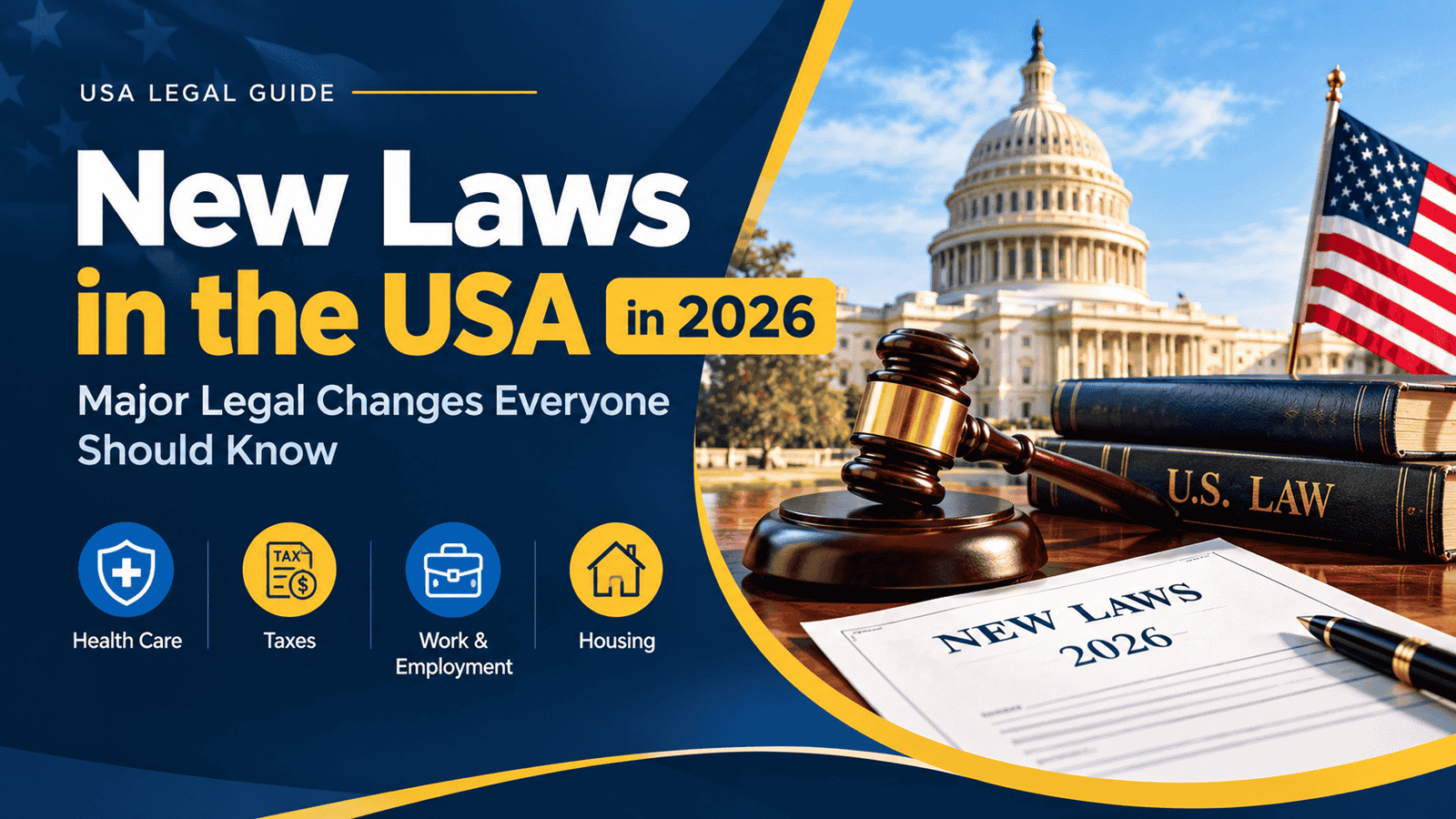
The United States continues to see important legal changes in 2026, affecting employment, taxes, healthcare, immigration, education, housing, technology, and everyday life. Some changes apply nationwide, while others are limited to individual states or cities.
For residents, workers, students, families, immigrants, and business owners, understanding these laws can help prevent costly mistakes and make it easier to recognize new rights and responsibilities.
One important point: there is no single list of new laws that applies to every American. Federal laws apply across the country within their legal scope, while state laws can differ significantly. This guide explains several important 2026 developments and shows readers how to check which rules apply to them.
1. Federal Laws and Legal Changes in 2026
Federal legislation can affect people throughout the United States, although a law may apply only to particular industries, programs, or groups.
The National Archives maintains an official list of federal public laws, including their titles, approval dates, and publication details. Readers can use this resource to confirm whether a law has actually been enacted rather than relying on a social media post or an unverified headline.
For the latest official information, visit the National Archives’ current public laws list.
When reviewing a new federal law, check three things:
- Effective date: The date the relevant provision begins to apply.
- Who is covered: The people, employers, organizations, or programs affected.
- Implementation rules: Whether a federal agency must issue additional guidance or regulations.
A law may be signed in one year but take effect later. Some provisions also have different effective dates, so reading only a headline can lead to misunderstandings.
2. New State Laws Taking Effect in 2026
State legislation is one of the most important parts of the 2026 legal landscape. A law introduced in California may have no effect on someone living in Florida, Texas, New York, or another state.
States can adopt different rules involving wages, housing, healthcare, consumer protection, education, transportation, privacy, and business operations.
California: Education, Health, Housing, and Workplace Rules
California announced several laws scheduled to take effect on January 1, 2026, covering areas such as education, healthcare, housing, workplaces, technology, and corporate disclosures.
One highlighted measure, Assembly Bill 1264, addresses ultra-processed foods served in public schools. The state also identified education-related measures involving student resources and support services.
The practical impact depends on the specific law and the institution involved. A school, employer, or company should review the applicable provision instead of assuming every new California law affects every resident in the same way.
Official resource: California Governor’s Office — New laws taking effect in 2026.
Arkansas: Grocery Taxes, Benefits, and Healthcare
Arkansas also introduced changes effective January 1, 2026. One highlighted measure removes a 0.125% state sales tax on groceries, although local sales taxes may still apply. Other measures address unemployment benefits, housing assistance, disability-related savings accounts, and healthcare coverage.
These examples show why it is important to look at the exact state and local rules. A change in one part of a tax system does not necessarily eliminate every tax charged on the same purchase.
Official resource: Arkansas Senate — Acts effective January 1, 2026.
North Carolina: Employment, Healthcare, and Professional Rules
North Carolina has also implemented legislation affecting areas such as prescription-drug pricing transparency, professional licensing, transportation planning, and certain employment rules.
For example, some measures address pathways for internationally trained doctors to seek professional licensure, while other legislation concerns prescription-drug costs and independent pharmacies.
The effect depends on the statute, its implementation date, and the person’s occupation or circumstances. Anyone working in a regulated profession should consult the relevant licensing board before relying on a general news summary.
3. Employment Laws and Workers’ Rights in 2026
Employment law is an important subject for employees and employers because even small legal changes can affect pay, workplace policies, and compliance responsibilities.
In the United States, employment rules come from federal law, state law, local ordinances, and sometimes collective bargaining agreements.
Minimum Wage and Overtime
There is no single minimum-wage figure that automatically describes every worker’s pay requirements across the country. Federal requirements establish a baseline for covered employees, while states and local governments may set higher minimum wages.
Overtime eligibility also depends on the applicable law and an employee’s classification. A job title alone does not necessarily determine whether a worker qualifies for overtime pay.
Employees should check:
- The minimum wage applicable to their work location.
- Whether they are legally classified as exempt or nonexempt.
- Whether overtime rules apply to their job and hours.
- State requirements for meal breaks, rest breaks, and final paychecks.
Employers should review official guidance before changing payroll systems or employee classifications.
For federal wage and hour information, visit the U.S. Department of Labor.
Workplace Policies and Employee Protections
Employers may need to review workplace policies when new state or federal requirements become effective. Depending on the jurisdiction, relevant topics can include paid leave, workplace safety, discrimination, pay transparency, and employee notices.
Employees should keep copies of pay statements, employment agreements, relevant schedules, and written communications when they believe their rights may have been violated.
However, not every workplace benefit is required by federal law. Paid leave, scheduling protections, and other benefits can vary by location and employer. Readers should verify their specific circumstances rather than assume a rule applies nationwide.
4. Tax Laws and Financial Rules in 2026
Tax law is another area where people should pay close attention to dates and eligibility requirements. Federal tax changes may affect income reporting, deductions, credits, business expenses, or other parts of a tax return. State income taxes and sales taxes follow separate rules.
A change announced during 2026 may apply to the 2026 tax year, a later tax year, or only certain transactions. It may also include income limits, documentation requirements, or special eligibility conditions.
Before filing a return, taxpayers should confirm:
- Which tax year the rule covers.
- Whether the provision has actually been enacted.
- Whether their income and filing status meet its requirements.
- Which records they need to keep.
- Whether their state tax treatment differs from federal treatment.
For accurate federal tax information, use the Internal Revenue Service. For state tax matters, consult the relevant state revenue department.
Taxpayers should be especially cautious about online posts promising guaranteed refunds or claiming that a new law automatically makes a particular expense deductible. Tax benefits generally depend on the exact statutory requirements.
5. Healthcare and Health Insurance Rules
Healthcare legislation can influence insurance coverage, public health programs, provider requirements, and access to certain services. However, the effect of a change may depend on the type of insurance, the state, the policy’s terms, and the effective date.
Arkansas, for example, identified 2026 measures addressing coverage for certain healthcare services. These are state-specific developments, not universal requirements for every insurance plan in America.
Before changing insurance coverage or assuming a treatment will be paid for, consumers should review:
- Their policy’s covered services and exclusions.
- Applicable state insurance requirements.
- Whether the plan is employer-sponsored, individual-market, or government-funded.
- Any eligibility, medical-necessity, or network requirements.
- The date on which a new coverage rule takes effect.
The Centers for Medicare & Medicaid Services provides federal information about Medicare, Medicaid, and related programs. State insurance departments can help explain local requirements and consumer complaint procedures.
6. Immigration Rules and Legal Requirements
Immigration rules can affect visa applicants, green-card applicants, employers, students, and families. Some immigration changes are federal, meaning they can apply across the United States, while their effects depend on the immigration category and the person’s circumstances.
A legal change should not be confused with a proposal, a court challenge, or an announcement that has not yet become effective.
People dealing with immigration applications should confirm:
- Which visa or immigration category applies.
- Whether the relevant rule is currently in force.
- Whether the rule applies to new applications, pending cases, or both.
- Whether official agency instructions have changed.
- Whether an exception or separate legal procedure applies.
The U.S. Citizenship and Immigration Services website provides official information about immigration benefits and procedures. The U.S. Department of State provides information about visas and consular services.
Because immigration consequences can be serious, applicants should obtain advice from a qualified immigration attorney or an authorized legal service provider when a decision depends on their individual circumstances.
7. Education Laws and Student Protections
Education laws in 2026 may affect public schools, colleges, universities, students, and educational institutions. Some changes are state-specific, while federal rules may apply to particular funding programs or legal protections.
California’s 2026 legislative announcement, for example, included measures related to student resources and public-school food standards.
Students and parents should check their own school district or university for changes to attendance policies, student services, tuition-related rules, financial aid requirements, and campus procedures.
International students should pay special attention to the conditions of their immigration status and any reporting or enrollment obligations that apply to them.
Useful starting points include the U.S. Department of Education and the education department of the relevant state.
8. Consumer Protection, Privacy, and Technology Laws
Digital privacy and technology regulation continue to develop across the United States. Depending on the jurisdiction, laws may govern how businesses collect personal information, provide privacy notices, handle consumer requests, or use certain technologies.
These requirements are not uniform nationwide. Businesses that operate online may need to consider the laws of multiple states, particularly when they serve customers in different jurisdictions.
Consumers can take practical steps to protect themselves:
- Read privacy notices before submitting sensitive information.
- Review account and advertising privacy settings.
- Be cautious about suspicious payment requests.
- Verify the identity of a business before sharing financial information.
- Use official complaint channels when a company appears to violate consumer-protection rules.
Businesses should review the statutes that apply to their operations and seek qualified legal advice before making compliance decisions.
9. Voting and Election Laws in 2026
Election laws are another area where state-level differences matter. Rules involving voter registration, identification, mail ballots, deadlines, and election administration can vary by state.
Some states have implemented new voting requirements in 2026, while particular provisions may face legal challenges. A headline about a proposed national rule should not be mistaken for a requirement that is already in force everywhere.
Eligible voters should verify their registration status, acceptable identification, registration deadlines, and ballot-return procedures through their official state or local election office.
The U.S. Election Assistance Commission provides election information and resources. For personal deadlines and local procedures, the relevant state or county election office is usually the most direct source.
10. Housing, Renting, and Property Laws
Housing rules can change at the state and local levels. Relevant subjects may include landlord-tenant obligations, eviction procedures, housing safety, property taxes, insurance, and consumer protections.
Renters should read their lease and check the laws applicable to their city and state. Landlords should verify required notices, deposit-handling rules, habitability standards, and court procedures before taking action against a tenant.
Property owners should also distinguish between a tax change, an insurance requirement, and a housing regulation. These are different legal issues and may be administered by different agencies.
For a housing dispute, a local legal-aid organization, housing agency, or qualified attorney can help explain which rules apply.
11. How to Find Out Which New Laws Apply to You
With so many changes happening at different levels of government, the most reliable approach is to verify the law using official sources.
Follow these steps:
Step 1: Identify your jurisdiction. Determine whether the issue involves federal law, your state, your county, or your city.
Step 2: Find the official source. Search the relevant government website, legislative database, or regulatory agency.
Step 3: Confirm the effective date. A law may have been passed but not yet taken effect.
Step 4: Read the scope and exceptions. Check who is covered, which activities are regulated, and whether exemptions exist.
Step 5: Check for updates or court decisions. A rule may be amended, delayed, challenged, or interpreted by a court.
Step 6: Seek professional help when needed. For tax, employment, immigration, housing, or other high-stakes matters, consult an appropriately qualified professional.
Useful official resources include:
- National Archives — Federal Public Laws
- U.S. Department of Labor
- Internal Revenue Service
- U.S. Citizenship and Immigration Services
- U.S. Department of Education
- U.S. Election Assistance Commission
Frequently Asked Questions
Are there new federal laws in the USA in 2026?
Yes. Federal legislation continues to be enacted during 2026. However, each law has its own scope, effective date, and implementation requirements. The National Archives is an official starting point for checking enacted federal public laws.
Do new U.S. laws apply in every state?
Not necessarily. Federal laws can apply nationwide within their scope, but state and local laws may apply only in specific jurisdictions. Some federal rules also cover only particular people, businesses, or programs.
Where can I check new laws in my state?
Start with your state’s official legislature or government website. Depending on the subject, the state labor department, revenue department, attorney general, election office, or other relevant agency may provide more practical guidance.
Can a proposed law affect me immediately?
A proposal does not automatically become law. Check whether it was enacted, when it takes effect, and whether a court or agency has changed how it operates.
Where can I get legal advice about a new law?
For individual legal questions, contact a qualified attorney or an authorized legal-aid organization. Official government websites explain rules and procedures, but they generally cannot determine how every law applies to your personal case.
Final Thoughts
The new laws and legal changes of 2026 cover a wide range of subjects, from state education and healthcare measures to employment, taxes, immigration, technology, and elections. Their effects depend on where a person lives, what they do, and which legal requirements apply to their situation.
The most useful habit is to verify a legal claim before acting on it. Check the official statute or government agency guidance, confirm the effective date, and seek professional advice when the consequences are significant.
Understanding the law is not only about avoiding penalties. It can also help people recognize their rights, meet their responsibilities, and make better-informed decisions throughout 2026.