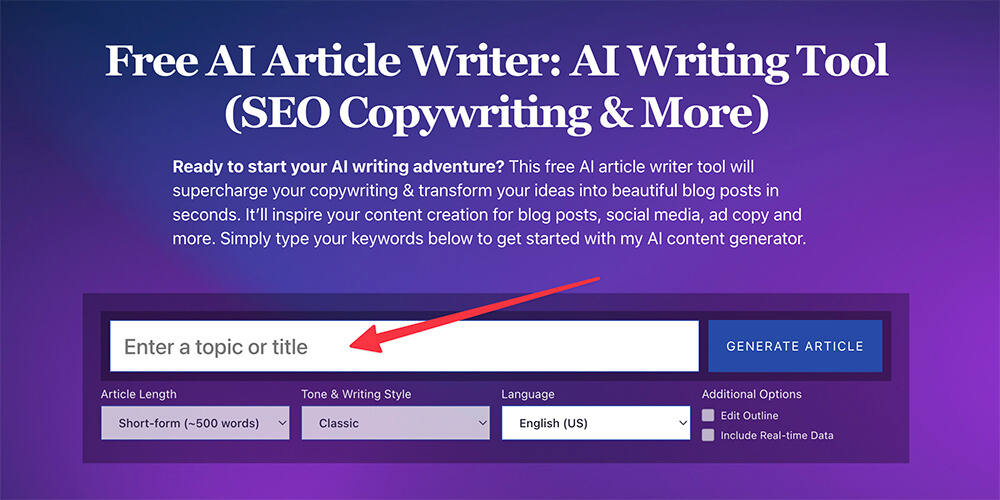
In March 2026, AI-powered article generators have become essential for bloggers, marketers, students, and content creators. These tools can produce drafts, outlines, full articles, or SEO-optimized content in seconds, often with free access to advanced models. While paid upgrades unlock unlimited usage or premium features, many offer robust free tiers capable of handling everyday needs.
This guide covers the best free AI article generator tools available right now. We focus on truly free options (or generous free plans), their strengths for article writing, limitations, and tips for best results. Always review and edit AI-generated content for accuracy, originality, and your unique voice—AI is a powerful assistant, not a replacement.
Top Free AI Article Generators in 2026
Here are the standout tools based on current performance, user feedback, and capabilities for generating articles, blog posts, and long-form content.
- ChatGPT (OpenAI) The most versatile all-rounder. Access to GPT-5.2 (or latest equivalent) in the free tier lets you generate full articles, outlines, introductions, or rewrites with detailed prompts.
- Best for: General articles, brainstorming, ideation, and editing drafts.
- Free limits: ~10 messages with advanced model every few hours (then falls back to a lighter model); unlimited basic chats.
- Pros: Conversational interface, excellent at following complex instructions, supports research summaries.
- Cons: Rate limits during peak times; occasional factual errors (always verify).
- How to use for articles: Prompt like: “Write a 1500-word SEO-optimized article on [topic] with headings, bullet points, and sources.”
- Claude (Anthropic) Often praised as the most “human-sounding” for long-form writing. Free access to Claude Sonnet 4.5 (or latest) excels at nuanced tone, creative angles, and coherent long articles.
- Best for: In-depth blog posts, thoughtful essays, or content needing natural flow.
- Free limits: 10–25 messages per 5-hour cycle (varies by demand).
- Pros: Superior for extended context and avoiding robotic phrasing.
- Cons: No built-in publishing tools; limits reset periodically.
- Tip: Use for editing or expanding outlines from other tools.
- Google Gemini Google’s free AI offers strong integration with search for up-to-date info and reliable article drafts.
- Best for: Research-heavy articles or fact-based content.
- Free limits: Generous daily usage with a Google account; advanced models available.
- Pros: Real-time web access in responses, good for current events.
- Cons: Sometimes more concise than verbose.
- How to use: Ask for structured articles with sources cited.
- Rytr A dedicated AI writing platform with templates tailored for articles and blogs.
- Best for: Short-to-medium articles, blog posts, or marketing content.
- Free limits: 10,000 characters/month (~2,500 words); includes 40+ use cases and plagiarism checker.
- Pros: User-friendly interface, tone customization, built-in tools.
- Cons: Character cap fills quickly for long articles.
- Upgrade path: Unlimited from $9/month.
- Grammarly AI Article Writer No-sign-up tool for quick article generation, plus the full Grammarly suite for editing.
- Best for: Fast drafts or polishing existing text.
- Free limits: Basic article generation; 100 generative prompts/month in the full tool.
- Pros: Seamless integration with editing/grammar checks.
- Cons: Not ideal for very long-form without limits.
- Tip: Generate → paste into Grammarly for instant improvements.
- Copy.ai Strong for marketing-oriented articles or structured content.
- Best for: Blog intros, outlines, or short-form articles.
- Free limits: Up to 2,000 words/month (or similar credit system).
- Pros: Pre-built workflows and templates.
- Cons: Better for shorter pieces than epic guides.
- Other Notable Mentions
- Perplexity AI: Great for researched articles with citations.
- QuillBot: Excellent paraphraser and expander for turning outlines into full text.
- Microsoft Copilot: Free Bing-integrated option for quick drafts.
Comparison Table
| Tool | Best For | Free Limits (Approx.) | Key Strength | Main Drawback |
|---|---|---|---|---|
| ChatGPT | Versatile article writing | 10+ advanced msgs/period | Flexibility & conversation | Rate limits |
| Claude | Long-form & natural tone | 10–25 msgs/5 hrs | Human-like quality | Variable daily caps |
| Gemini | Research-based content | Generous daily | Web-integrated facts | Less creative sometimes |
| Rytr | Blog & short articles | 10k characters/mo | Templates & ease | Character limit |
| Grammarly AI | Quick drafts + editing | Limited generative prompts | Polishing integration | Not full long-form focus |
Tips for Getting the Best Results in 2026
- Craft strong prompts: Be specific—include word count, tone, structure (e.g., H2 headings, bullet lists), target audience, and keywords.
- Combine tools: Generate a draft in ChatGPT/Claude → research facts in Gemini/Perplexity → edit in Grammarly.
- Check for originality: Use built-in checkers (Rytr) or free plagiarism tools.
- Stay ethical: Disclose AI use when required (e.g., academic work) and avoid publishing unedited AI content as your own.
- Handle limits: Spread usage across tools or times of day.
The free tier landscape in 2026 is incredibly capable—thanks to ongoing model improvements from OpenAI, Anthropic, Google, and others. Start with ChatGPT or Claude for most article needs, and experiment to find your favorite workflow. If your volume grows, affordable paid plans (often $9–20/month) remove limits entirely.